
Persistent DEVICE client
This page explains how TBMQ stores and delivers messages for persistent DEVICE clients, covering the original PostgreSQL-based design, its limitations, and the Redis-based architecture introduced in v2.0.
In TBMQ 1.x, PostgreSQL handled message persistence and retrieval for persistent DEVICE clients. While it performed well initially, PostgreSQL could only scale vertically. As the number of persistent MQTT sessions grew, its architecture became a bottleneck. Redis was chosen as the replacement due to its horizontal scalability, native clustering support, and widespread adoption.
Where persistence fits in the message flow
Section titled “Where persistence fits in the message flow”Redis is not on the publisher’s critical path. A publish is acknowledged once Kafka has accepted it; the DEVICE copy is written to Redis afterwards, by a separate consumer:
- The message is appended to
tbmq.msg.alland the publisher is acknowledged. - The message dispatcher matches
subscribers. For every persistent DEVICE subscriber it produces a copy to
tbmq.msg.persisted(12 partitions by default), keyed by client ID — so all messages for one client stay in one partition, in order, and are always handled by the same consumer. - A
tbmq.msg.persistedconsumer (3 consumers and 3 threads by default) groups the polled batch per client ID and makes one atomic Redis call per client, which stores the whole group and assigns its MQTT packet IDs. - That call returns the packet ID in use before the batch, so the broker can re-derive the same IDs the script
assigned and hand each message to the node where the client is connected — in process if that is this node,
otherwise over
tbmq.msg.downlink.persisted.$SERVICE_ID. - If the client is offline, step 4 is skipped entirely: the copy simply stays in Redis until the client reconnects.
Two practical consequences follow. Redis is sized by the number of pending messages rather than by throughput, and a brief Redis problem does not lose an accepted message, because Kafka still holds it and the consumer retries the write.
That retry budget is finite, though. Each pack waits TB_DEVICE_PERSISTED_MSG_PACK_PROCESSING_TIMEOUT (20 s) for its
Redis calls, and TB_DEVICE_PERSISTED_MSG_ACK_STRATEGY_TYPE defaults to RETRY_ALL with
TB_DEVICE_PERSISTED_MSG_ACK_STRATEGY_RETRIES = 3 and a 1 s pause between attempts. Once those are exhausted the
Kafka offset is committed anyway: the copies that never reached Redis are counted as dropped in the broker’s
statistics and the stream moves on, rather than stalling behind an unreachable Redis. Set the retry count to 0 for
unlimited retries if you would rather have the persisted-message stream block until Redis recovers.
Two rules decide whether a copy is stored at all, and both must pass: the publisher must have used QoS 1 or 2, and the subscription must have been made with QoS 1 or 2. A QoS 0 publish is never persisted for anyone, and a QoS 0 subscription of a persistent client receives messages only while it is connected.
PostgreSQL — original design
Section titled “PostgreSQL — original design”In TBMQ 1.x, persistent DEVICE clients used PostgreSQL for message persistence. Two tables were central to this design.
device_session_ctx — maintained session state per persistent MQTT client:
Table "public.device_session_ctx" Column | Type | Nullable--------------------+------------------------+--------- client_id | character varying(255) | not null last_updated_time | bigint | not null last_serial_number | bigint | last_packet_id | integer |Indexes: "device_session_ctx_pkey" PRIMARY KEY, btree (client_id)last_packet_id— packet ID of the last MQTT message received.last_serial_number— ever-increasing counter; prevents ordering issues when the MQTT packet ID wraps around at 65535.
device_publish_msg — stored messages pending delivery to persistent subscribers:
Table "public.device_publish_msg" Column | Type | Nullable--------------------------+------------------------+--------- client_id | character varying(255) | not null serial_number | bigint | not null topic | character varying | not null time | bigint | not null packet_id | integer | packet_type | character varying(255) | qos | integer | not null payload | bytea | not null user_properties | character varying | retain | boolean | msg_expiry_interval | integer | payload_format_indicator | integer | content_type | character varying(255) | response_topic | character varying(255) | correlation_data | bytea |Indexes: "device_publish_msg_pkey" PRIMARY KEY, btree (client_id, serial_number) "idx_device_publish_msg_packet_id" btree (client_id, packet_id)Key columns:
time— system timestamp when the message was stored; used for periodic cleanup of expired messages.msg_expiry_interval— expiration time (seconds) for MQTT 5.0 messages with an expiry property. If absent, the message remains valid until removed by time or size-based cleanup.
When messages arrive for a client from the shared Kafka topic, the broker queries device_session_ctx to fetch
the latest last_packet_id and last_serial_number. These are incremented and assigned to each message before
insertion into device_publish_msg.
Limitation: based on the TimescaleDB blog, vanilla PostgreSQL handles up to ~300k inserts per second under ideal conditions, but this depends on hardware, schema, and workload. Vertical scaling can extend this ceiling, but a per-table hard limit is eventually reached. For an MQTT broker expecting millions of persistent sessions, this was a fundamental constraint.
Redis — scalable architecture (v2.0+)
Section titled “Redis — scalable architecture (v2.0+)”Redis was chosen as the replacement due to in-memory operation (low latency), native cluster support, and horizontal scalability. The migration also enabled replacing periodic time-based cleanup with per-message TTL.
Redis Cluster constraints
Section titled “Redis Cluster constraints”Using multiple Redis data structures per client means using multiple keys per persistent session. Redis Cluster distributes keys across hash slots for horizontal scaling, but multi-key operations must target the same slot — otherwise a cross-slot error is raised.
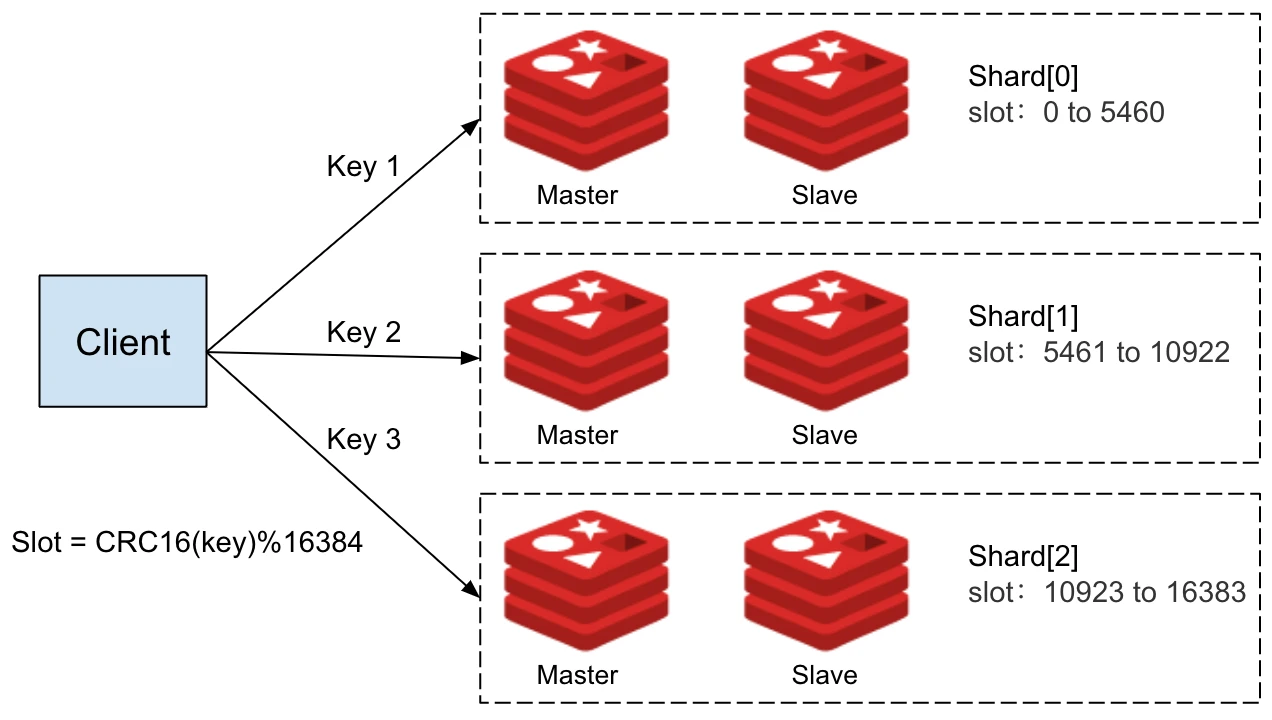
TBMQ uses the persistent MQTT client ID as a hash tag
in key names — the client ID is enclosed in {}. Redis hashes all keys sharing the same {} content to the same
slot, guaranteeing that all keys for one client reside together and multi-key operations proceed without errors.
The keys are laid out this way regardless of topology, so the same code path works for all three supported
connection types — REDIS_CONNECTION_TYPE accepts standalone (the default), cluster, and sentinel. Every key
can also carry a common prefix (CACHE_PREFIX, empty by default), which is applied before the hash tag, so it
never breaks slot co-location.
Atomic operations via Lua scripts
Section titled “Atomic operations via Lua scripts”In high-throughput environments, multiple messages can arrive simultaneously for the same client. Without atomic operations, sequential updates to multiple data structures risk race conditions and partial updates, leading to message loss or incorrect ordering.
Lua scripts execute as a single isolated unit — no other commands can run concurrently during execution. TBMQ uses a separate Lua script per operation, ensuring all keys accessed within a script reside in the same hash slot and all updates are atomic:
| Script | Invoked when | What it does |
|---|---|---|
| add messages | a batch arrives from tbmq.msg.persisted |
assigns packet IDs, writes payloads with TTL, appends to the sorted set, trims to the limit |
| get messages | the client connects | returns all pending messages oldest-first and prunes references to expired ones |
| remove message | PUBACK or PUBCOMP received | deletes one payload key and its sorted-set reference |
| update packet type | PUBREC received | rewrites the stored copy as a PUBREL marker |
| remove messages | session is cleared | deletes every payload key, the sorted set, and the packet-ID counter |
All five are loaded with SCRIPT LOAD at startup and afterwards invoked by SHA (EVALSHA), so the script body
is not shipped with every call. If Redis has forgotten the script — after a restart, a failover, or a
SCRIPT FLUSH — the NOSCRIPT error is caught, the script is reloaded once (concurrent callers share that single
reload), and the call is retried; a plain EVAL with the full body is the last-resort fallback.
Redis data structures
Section titled “Redis data structures”TBMQ uses two Redis data structures per client, across three keys:
| Key | Type | Holds |
|---|---|---|
{clientId}_messages |
sorted set | one reference per pending message, ordered by score |
{clientId}_messages_{packetId} |
string | the message itself, with a TTL |
{clientId}_last_packet_id |
string | the last MQTT packet ID assigned to this client |
Sorted sets (ZSETs) — maintain message order using the score as a continuously increasing counter (equivalent
to serial_number in PostgreSQL). The sorted set stores references to message payload keys, not the payloads
themselves, to avoid memory overhead and enable per-message TTL.
Strings — store the full message payload with a TTL (EX), providing O(1) write, read, and delete
complexity without affecting the sorted set.
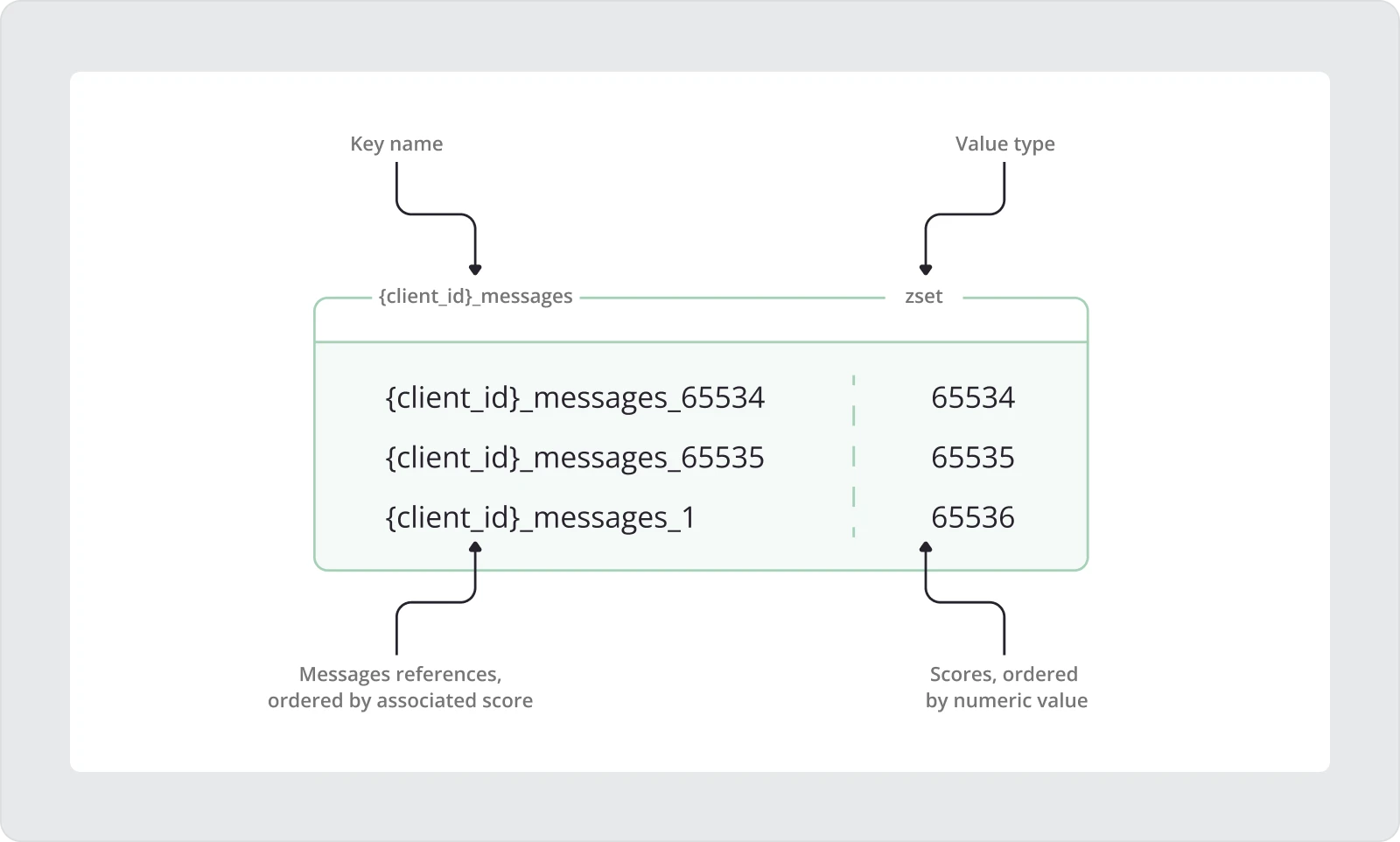
Example — adding messages to the sorted set:
# Message with MQTT packet ID 65534ZADD {client_id}_messages 65534 {client_id}_messages_65534
# Message with packet ID 65535 (maximum)ZADD {client_id}_messages 65535 {client_id}_messages_65535
# Packet ID wraps around to 1 — score continues growing to 65536ZADD {client_id}_messages 65536 {client_id}_messages_1
The score grows monotonically even when the MQTT packet ID wraps at 65535, preserving correct message ordering.
Packet IDs are assigned inside the script, not by the caller. For each message in the batch the script
increments the stored last_packet_id (wrapping from 65535 back to 1), writes that ID into the message, and names
the payload key after it. The score is a separate counter, seeded from the highest score currently in the sorted
set — or from last_packet_id when the set is empty — and incremented once per message. Two messages therefore
never collide on a score even though their packet IDs eventually repeat. The script returns the packet ID that was
in use before the batch, which is how the broker re-derives the same IDs for the copies it forwards to the node
holding the connection.
Example — storing a message payload with TTL:
SET {client_id}_messages_1 "{ \"packetType\":\"PUBLISH\", \"payload\":\"eyJkYXRhIjoidGJtcWlzYXdlc29tZSJ9\", \"time\":1736333110026, \"clientId\":\"client\", \"retained\":false, \"packetId\":1, \"topicName\":\"europe/ua/kyiv/client/0\", \"qos\":1}" EX 600The EX value is per message: it is the MQTT 5.0 Message Expiry Interval the publisher sent, and when the
message carries none, the broker-wide default MQTT_PERSISTENT_SESSION_DEVICE_PERSISTED_MESSAGES_TTL (604800 s —
one week). This replaces the periodic cleanup job the PostgreSQL design needed: an expired message disappears on
its own, and only its now-dangling reference in the sorted set is left to prune (see
Message retrieval and cleanup on reconnect).
Message payloads can also be retrieved or removed individually with O(1) complexity, without affecting the sorted set:
GET {client_id}_messages_1DEL {client_id}_messages_1Last packet ID — a separate string key stores the last MQTT packet ID assigned:
GET {client_id}_last_packet_id"1"This is needed on reconnect to determine the correct packet ID for the next message. The sorted set cannot be relied on for this because it may be empty or fully removed.
Managing sorted set size
Section titled “Managing sorted set size”The maximum number of stored messages per persistent DEVICE client is controlled by:
# Maximum number of PUBLISH messages stored for each persisted DEVICE clientlimit: "${MQTT_PERSISTENT_SESSION_DEVICE_PERSISTED_MESSAGES_LIMIT:10000}"This limit controls memory allocation per persistent client. For example, a client might connect, register a persistent session, and then disconnect immediately. Without a limit, messages would accumulate indefinitely while waiting for a potential reconnection, causing unbounded memory usage.
The maximum configurable value is 65535 (MQTT protocol limit) — the broker validates this on startup and refuses to
start with a higher value. When new messages arrive and the limit is reached, the oldest messages are trimmed from
the sorted set and their payload string keys are deleted. This runs at the end of the same script that stores the
batch, so a client never observes more than limit pending messages:
-- Get the number of elements to be removedlocal numElementsToRemove = redis.call('ZCARD', messagesKey) - maxMessagesSize-- Check if trimming is neededif numElementsToRemove > 0 then -- Get the elements to be removed (oldest ones) local trimmedElements = redis.call('ZRANGE', messagesKey, 0, numElementsToRemove - 1) -- Iterate over the elements and remove them for _, key in ipairs(trimmedElements) do -- Remove the message from the string data structure redis.call('DEL', key) -- Remove the message reference from the sorted set redis.call('ZREM', messagesKey, key) endendMessage retrieval and cleanup on reconnect
Section titled “Message retrieval and cleanup on reconnect”When a DEVICE client reconnects, undelivered messages are retrieved and references to expired messages are cleaned up at the same time:
local messagesKey = KEYS[1]local maxMessagesSize = tonumber(ARGV[1])local elements = redis.call('ZRANGE', messagesKey, 0, -1)local messages = {}for _, key in ipairs(elements) do if redis.call('EXISTS', key) == 1 then local msgJson = redis.call('GET', key) table.insert(messages, msgJson) else -- Expired — remove the stale reference from the sorted set redis.call('ZREM', messagesKey, key) endendreturn messagesZRANGE messagesKey 0 -1 walks the set by ascending score, so messages come back oldest first and are
re-delivered in their original order. Each returned message carries the packetType it was stored with, and that
field decides what the client actually receives (see below).
Acknowledgement and removal
Section titled “Acknowledgement and removal”Nothing is removed at delivery time — a message leaves Redis only when the client has confirmed it, which is what makes redelivery after a dropped connection possible:
| Client sends | TBMQ does |
|---|---|
| PUBACK (QoS 1) | removes the payload key and its sorted-set reference |
| PUBREC (QoS 2) | rewrites the stored copy with packetType = PUBREL, then sends PUBREL |
PUBREC with an MQTT 5 error reason code (0x80 or higher) |
removes the payload key and its reference, and sends no PUBREL — the client refused the message, so the exchange ends there |
| PUBCOMP (QoS 2) | removes the payload key and its sorted-set reference |
Rewriting the stored copy is what makes a QoS 2 handshake resumable. If the connection drops between PUBREC and PUBCOMP, the pending entry is no longer a PUBLISH: on reconnect the client receives a PUBREL for that packet ID rather than the payload again, so the exchange continues where it stopped instead of restarting — and the payload is not transmitted twice.
Clearing a session
Section titled “Clearing a session”When a session ends for good — a clean start connect, an expired session, or an admin clearing it — a single
script deletes every payload key, the sorted set, and the packet-ID counter, leaving no orphaned keys behind. See
Clean persistent sessions for
the operations that trigger this.
Delivery, DUP flag, and backpressure
Section titled “Delivery, DUP flag, and backpressure”Delivery is driven by the client’s DEVICE actor, which owns the session’s in-flight state:
- DUP flag — the actor tracks the packet IDs it has already sent. A message re-sent with a packet ID that is
still in flight goes out with
DUP = 1. - Expiry re-check — expiry is evaluated again just before delivery, and the remaining interval is written into the outgoing message’s properties, so a client that reconnects after an hour sees an accurate remaining TTL rather than the publisher’s original value.
- Backpressure — when Netty reports the channel non-writable (the client is reading too slowly), the actor stops delivering instead of buffering unboundedly. Once the channel is writable again it re-reads the pending set from Redis, with an exponential backoff while acknowledgements are still outstanding. Nothing is lost, because nothing was removed. See Backpressure.
- Actor lifetime — after a disconnect the actor is kept alive for
ACTORS_SYSTEM_PERSISTED_DEVICE_WAIT_BEFORE_ACTOR_STOP_MINUTES(5 minutes by default), so a quick reconnect reuses the warm in-memory state instead of rebuilding it.
Delivery is flushed per message by default for persistent DEVICE clients, which favors latency; buffering is available for throughput-oriented deployments. Both are covered in Message delivery strategies. Note that APPLICATION clients default the other way.
Shared subscriptions
Section titled “Shared subscriptions”DEVICE clients do not use Kafka consumer groups for shared subscriptions the way APPLICATION clients do. TBMQ picks exactly one target per message, at dispatch time:
- A member is connected — a round-robin strategy selects one connected member (skipping a local member whose channel is currently non-writable), and the message follows the ordinary DEVICE path, stored under that member’s client ID.
- No member is connected, at least one has a persistent session — the message is stored under the subscription’s own key (topic filter + share name) instead of any client ID. The group thus has a single shared backlog rather than one copy per member.
- No member is connected and none is persistent — the message is dropped for that group.
When a member later connects, it drains the group’s backlog only if no other DEVICE member of that subscription is already connected — otherwise new messages are being routed to that member instead. While draining, packet IDs are re-mapped into the reconnecting client’s own sequence (the mapping back to the stored IDs is kept in memory so acknowledgements still remove the right entries), the QoS is downgraded to the subscription’s QoS, and the subscription identifier is attached.
A shared subscription established with QoS 0 is skipped when draining: its messages are delivered at QoS 0, are never acknowledged, and are left for another member or for the TTL to remove.
Migration from Jedis to Lettuce
Section titled “Migration from Jedis to Lettuce”To validate Redis scalability, TBMQ was tested with a P2P MQTT pattern — one publisher per subscriber, each pair creating its own persistent session. This stresses exactly the per-session write path Redis needs to handle.
A pre-migration prototype test established a 30k msg/sec ceiling with PostgreSQL. After migrating to Redis with the existing Jedis client (synchronous), throughput reached only 40k msg/sec — a modest improvement because Jedis processes each Redis command sequentially, blocking until completion before issuing the next.
Migrating to Lettuce, an asynchronous client built on Netty, raised throughput to 60k msg/sec by enabling parallel, non-blocking Redis operations.
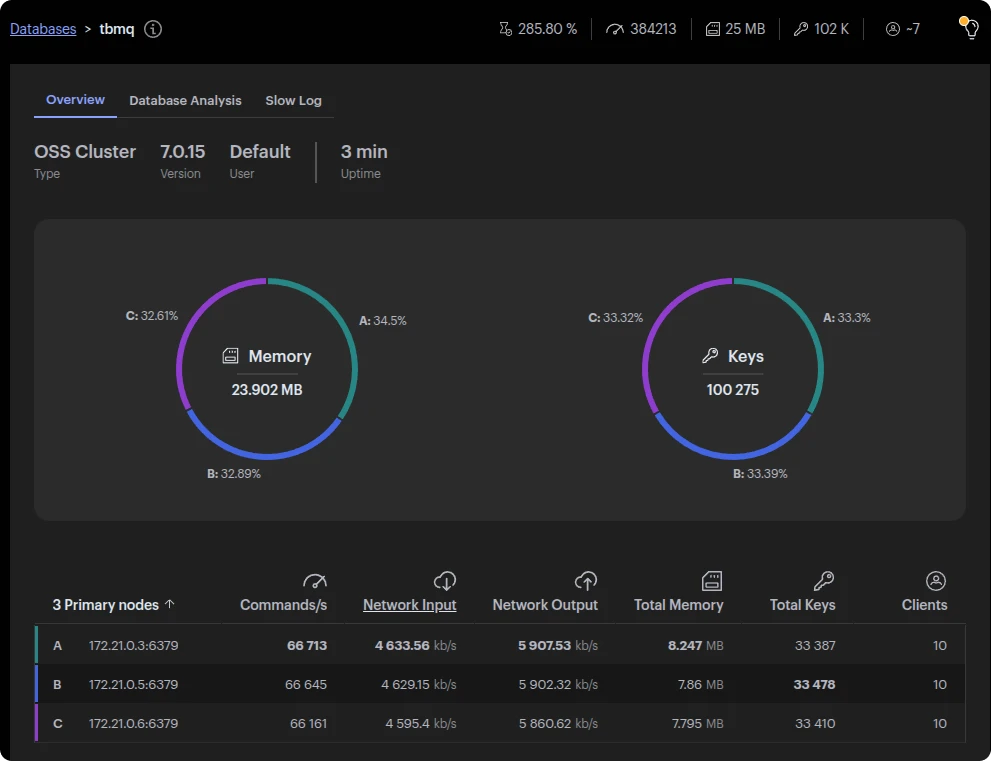
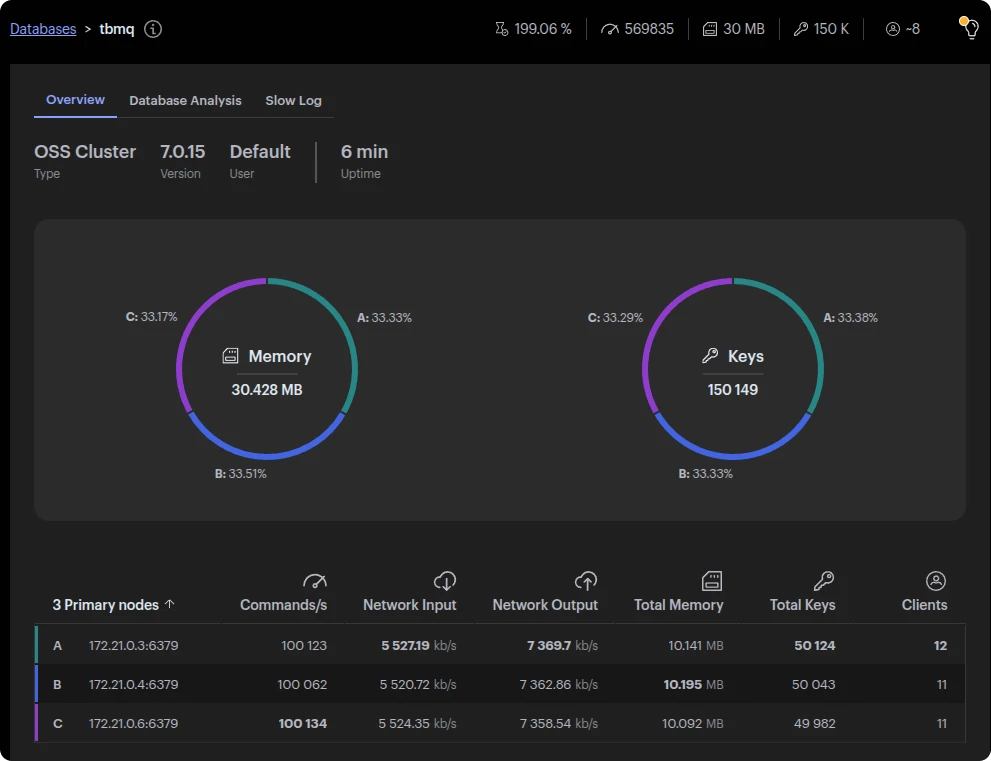
For the full P2P performance test methodology and results, see the 1M msg/sec P2P performance test.
Summary
Section titled “Summary”| Aspect | Persistent DEVICE client |
|---|---|
| Offline storage | Redis — a sorted set of references plus one string per message, per client |
| Consumer model | Shared tbmq.msg.persisted consumers (3 by default), batched per client ID |
| Message delivery | Delivered by the client’s DEVICE actor; each message removed only once acknowledged |
| Flow control | Netty writability stops delivery; the pending set is re-read when the channel recovers |
| Session recovery | Pending messages replayed oldest-first; an interrupted QoS 2 exchange resumes at PUBREL |
| Message expiry | Per-message TTL — MQTT 5 Message Expiry Interval, else the broker default (1 week) |
| Cluster inter-node traffic | tbmq.msg.downlink.persisted.$SERVICE_ID when the client is connected to another node |
| Shared subscription support | One target chosen per message; a group backlog is stored under the subscription key |
| Session requirement | Persistent session and subscription QoS > 0 |
| Typical use cases | Devices, sensors, and mobile clients with intermittent connectivity |
For the opposite trade-off — a dedicated Kafka topic and consumer per client, sized for high-rate backend consumers — see persistent APPLICATION clients.
Was this helpful?